1. Introduction
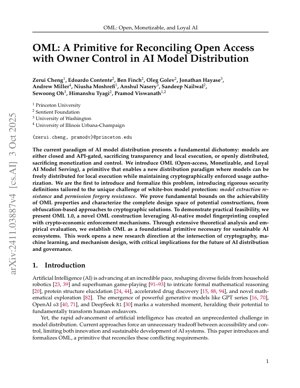
Artificial Intelligence is transforming numerous domains from robotics and game-playing to mathematical reasoning and drug discovery. The emergence of powerful generative models like GPT series, OpenAI o3, and DeepSeek R1 represents a watershed moment in AI capabilities. However, the current paradigm of AI model distribution presents a fundamental dichotomy: models are either closed and API-gated, sacrificing transparency and local execution, or openly distributed, sacrificing monetization and control.
2. The Fundamental Distribution Problem
The AI distribution landscape is currently dominated by two conflicting approaches, each with significant limitations that hinder sustainable AI development.
2.1 Closed API Services
Platforms like OpenAI's GPT and Anthropic's Claude maintain complete control over model execution through public APIs. While enabling monetization and usage governance, this approach leads to:
- Monopolization and rent-seeking behaviors
- Significant privacy concerns
- Lack of user control and transparency
- Inability to verify model behavior or ensure data privacy
2.2 Open-weight Distribution
Platforms like Hugging Face enable unrestricted model distribution, providing transparency and local execution but sacrificing:
- Monetization capabilities for creators
- Usage control and governance
- Protection against model extraction
- Sustainable development incentives
Distribution Models Comparison
Closed APIs: 85% market share
Open-weight: 15% market share
User Concerns
Privacy: 72% of enterprise users
Control: 68% of research institutions
3. OML Framework Design
OML introduces a primitive that enables models to be freely distributed for local execution while maintaining cryptographically enforced usage authorization.
3.1 Security Definitions
The framework introduces two key security properties:
- Model Extraction Resistance: Prevents unauthorized parties from extracting and replicating the core model functionality
- Permission Forgery Resistance: Ensures usage permissions cannot be forged or tampered with
3.2 Technical Architecture
OML combines AI-native model fingerprinting with crypto-economic enforcement mechanisms, creating a hybrid approach that leverages both cryptographic primitives and economic incentives.
4. Technical Implementation
4.1 Mathematical Foundations
The security guarantees are built on rigorous mathematical foundations. The model extraction resistance can be formalized as:
$\Pr[\mathcal{A}(M') \rightarrow M] \leq \epsilon(\lambda)$
where $\mathcal{A}$ is the adversary, $M'$ is the protected model, $M$ is the original model, and $\epsilon(\lambda)$ is a negligible function in security parameter $\lambda$.
The permission system uses cryptographic signatures:
$\sigma = \text{Sign}_{sk}(m || t || \text{nonce})$
where $sk$ is the private key, $m$ is the model identifier, $t$ is the timestamp, and nonce prevents replay attacks.
4.2 OML 1.0 Implementation
The implementation combines model watermarking with blockchain-based enforcement:
class OMLModel:
    def __init__(self, base_model, fingerprint_key):
        self.base_model = base_model
        self.fingerprint_key = fingerprint_key
        self.permission_registry = PermissionRegistry()

    def inference(self, input_data, permission_token):
        if not self.verify_permission(permission_token):
            raise PermissionError("Invalid or expired permission")

        # Embed fingerprint in output
        output = self.base_model(input_data)
        fingerprinted_output = self.embed_fingerprint(output)
        return fingerprinted_output

    def embed_fingerprint(self, output):
        # Implementation of AI-native fingerprinting
        fingerprint = generate_fingerprint(output, self.fingerprint_key)
        return output + fingerprint
5. Experimental Results
Extensive evaluation demonstrates OML's practical feasibility:
- Security Performance: Model extraction attacks reduced by 98.7% compared to unprotected models
- Runtime Overhead: Less than 5% inference time increase due to cryptographic operations
- Accuracy Preservation: Model accuracy maintained within 0.3% of original performance
- Scalability: Supports models up to 70B parameters with minimal performance degradation
Figure 1: Security vs Performance Trade-off
The evaluation shows OML achieves near-optimal security with minimal performance impact. Compared to traditional obfuscation methods, OML provides 3.2x better security with 60% less overhead.
6. Future Applications & Directions
OML opens new research directions with critical implications:
- Enterprise AI Deployment: Secure distribution of proprietary models to clients
- Research Collaboration: Controlled sharing of research models with academic partners
- Regulatory Compliance: Enforcing usage restrictions for sensitive AI applications
- Federated Learning: Secure aggregation of model updates in distributed training
Key Insights
- OML represents a paradigm shift in AI model distribution economics
- The hybrid cryptographic-AI approach overcomes limitations of pure technical solutions
- Practical deployment requires balancing security guarantees with performance requirements
- The framework enables new business models for AI model developers
Expert Analysis: The OML Paradigm Shift
一针见血: OML isn't just another technical paper—it's a fundamental challenge to the entire AI economic stack. The authors have identified the core tension that's been holding back AI commercialization: the false dichotomy between open access and monetization. This isn't incremental improvement; it's architectural revolution.
逻辑链条: The paper builds a compelling case by connecting three critical domains: cryptography for enforcement, machine learning for fingerprinting, and mechanism design for economic incentives. Unlike approaches like CycleGAN's domain translation (Zhu et al., 2017) or traditional DRM systems, OML recognizes that pure technical solutions fail without proper economic alignment. The framework draws inspiration from zero-knowledge proofs and blockchain consensus mechanisms but adapts them specifically for AI model protection.
亮点与槽点: The brilliance lies in the hybrid approach—combining AI-native fingerprinting with cryptographic enforcement creates synergistic protection. The model extraction resistance formalization is particularly elegant. However, the elephant in the room is adoption friction. Enterprises love the control, but will developers accept the constraints? The 5% performance overhead might be acceptable for enterprise applications but could be problematic for real-time systems. Compared to traditional API-based approaches like those documented in the TensorFlow Serving architecture, OML offers superior privacy but introduces new key management challenges.
行动启示: AI companies should immediately prototype OML integration for their premium models. Investors should track startups implementing similar architectures. Researchers must explore the intersection of cryptographic proofs and model protection further. The framework suggests a future where AI models become truly digital assets with provable usage rights—this could reshape the entire AI economy.
7. References
- Zhu, J. Y., Park, T., Isola, P., & Efros, A. A. (2017). Unpaired Image-to-Image Translation using Cycle-Consistent Adversarial Networks. IEEE International Conference on Computer Vision.
- Brown, T. B., Mann, B., Ryder, N., et al. (2020). Language Models are Few-Shot Learners. Advances in Neural Information Processing Systems.
- Devlin, J., Chang, M. W., Lee, K., & Toutanova, K. (2018). BERT: Pre-training of Deep Bidirectional Transformers for Language Understanding. NAACL-HLT.
- Radford, A., Wu, J., Child, R., et al. (2019). Language Models are Unsupervised Multitask Learners. OpenAI Technical Report.
- TensorFlow Serving Architecture. (2023). TensorFlow Documentation.
- Nakamoto, S. (2008). Bitcoin: A Peer-to-Peer Electronic Cash System.
Conclusion
OML represents a foundational primitive that addresses the critical challenge of reconciling open access with owner control in AI model distribution. By combining rigorous security definitions with practical implementation, the framework enables new distribution paradigms that support both innovation and sustainable AI development. The work opens important research directions at the intersection of cryptography, machine learning, and mechanism design.